Showing posts with label Black Library. Show all posts

Wednesday, July 18, 2012

Review: Priests of Mars


Having just finished (New York Times bestselling author) Graham McNiell's latest Black Library offering Priests of Mars, I felt I should offer up my thoughts on the book.

It tells the tale of a nominally Adeptus Mechanicus expedition into uncharted space to find a long lost explorator fleet. I say nominally because not only is there the AdMech, but a Rogue Trader, some Imperial Guard, Space Marines (Black Templars) and some freshly pressed ships crew getting their slice of the pie.

So a rather motley crew.


Our main characters are the aforementioned Rogue Trader, who far from being a dashing rogue presents a more thoughtful, if rebellious at times, take on that archetype. His motivations are not entirely clear and may even put him at odds with his shipmates


He has a card playing, womanising, smart ass Han Solo-esque sidekick of course


They are bringing along a talented stelar cartographer whose work is vital to the missions success


Butt heads with serious company types


Meet a variety of crazy characters


And they all have the best summer ever


Not quite...


This is 40k after all (and the Eldar get a look in too).


Without getting into too much of the plot, this is the sort of book I hope to see more of from the Black Library. It is a book about the characters, rather than a book about things happening to characters. They drive almost the entire plot, from the inception of the expedition to the petty (and not so petty) power plays that form the bulk of the interaction.

My beef with some BL novels has been that they've shoehorned in combat almost as if they feel it's expected to have some explosions as, hey, it's 40k right? A Thousand Sons had that weird bit with the Psychneuein and Cain often will ahve random mooks to fight, but Priest of Mars has a few pages of fisticuffs in a duel, and a bit of combat towards the end, but the novel wouldn't be drastically thinner without it.

I like that the BL is progressing beyond the need to have combat be all we see in the 40k universe, as there are many other aspects worth exploring besides war, and what better way than a good novel? I think that A Thousand Sons, Mechanicum and Outcast Dead have been some of the best recieved novels (from what I've seen and heard) shows that the fanbase is prepared to accept these novels as well.


But I digress.


The expedition generally goes pretty smoothly, but they may really have someone unseen pulling their strings


The book itself maintains a great sense of tension throughout - getting towards the end there was a very real expectation that it was all just going to go horribly pear shaped and end up with everyone dying horribly, especially when they start the actual exploratoring


Of course I won't say what happens exactly, but the one fault of the book is that it feels like the ending is pretty strong sequel bait (or a setup for a new series even). While I wouldn't be opposed to this, and would very happily buy any continuation, I am somewhat wary.
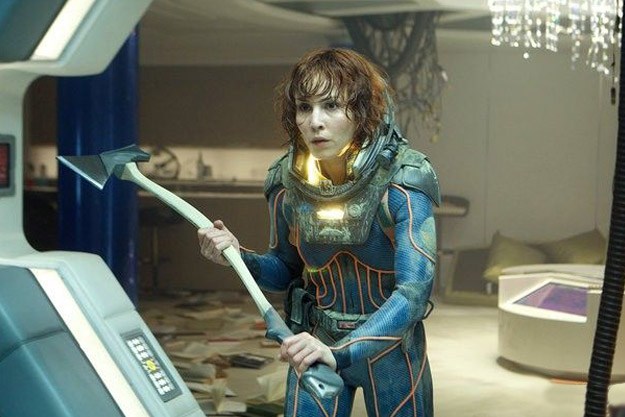
As with Prometheus, Priests of Mars ends with just as many questions as answers. I'm not entirely opposed to this as everything, while not finalised, is settled. It is a matter of personal taste but I've been feeling very much over the tide of sequels and remakes in almost everything lately (movies are my other great love aside from books). It irritates me no end to pick up a book, look at the back and like the synopsis only to see it's book three of the whatever dodecadology, first of the whocares cycle.
I blame Isobelle Carmody for taking forever to write the rest of the Obernewtyn books, personally.

Where'd I leave that tangent picture..?


Eh, doctor looking skeptical will have to do.


So anyways, Priests of Mars is a great book, and has terrific insights into not only Mechanicus society and mindset (there's a wonderful discussion of it between the Rogue Trader and the cartographer on the subject), but a few other nuggets, most notable of which is comfirmation that Sororitas (at least Hospitallers) can get married and a link to the Horus Heresy (rather spoilery, highlight between the pics to read:


- the Kaban machine is still kicking around in some capacity


So get this book if you liked any of McNiell's recent offerings or have a hankering for the non-dakka side of the Imperium. Even if you don't get it, as it will likely change your opinion.

Final score: 9.5/10 lost 1/2 a point for the sequel bait - sorry Graham, I still love you!

Wednesday, November 23, 2011

Reviews: Outcast Dead, Eisenhorn, Ravenor, Hive of the Dead, Aurelian, Snuff

Real life, by way of jury duty, has gotten in the way of late - but it did afford me time to get some reading done.


The Outcast Dead
, by Graham McNiell.

This book is a must buy for fans of the Heresy series, and fans of 40k lore. Some of the important things it lays out include the exact timeline of the Isstvaan attacks in relation to Magnus' stuffing around, and a lot of vital background on the workings of the formative Imperium.

Following Astropath Kai Zulane as he comes to grips with a terrible secret that could dictate the course of war (or end it entirely), the story shows how the ideals of the Imperial Truth are often at odds with the actions of its most trusted guardians.
The Outcast Dead themselves are a group of marines stationed on Terra, belonging to the mysterious Crusader Host. McNiell does his trademark 'refer obliquely to something and wait to explain it in another book' trick here, but it's not especially intrusive or distracting to the narrative.

Possibly the best part of the book, for me at least, is making the Emperor more human. In most of his appearances, especially in the early books (and the awful Last Church [ironically also by McNiell]) The Emperor was often portrayed as either excessively God-like, with everyone falling to their knees and weeping, or as a jerkface (who has the face of a jerk). This also extended to the Primarchs to a lesser degree.
The obvious problem with this is that he becomes either unrelatable or unlikable, not to mention the plot hole of 'why is there political strife on Terra when the Emperor just needs to show up and bling out and everyone falls before him weeping (always with the weeping)?' This is the problem of having to tell the really important stuff - ie Horus' fall - first, when it would have been better served to get a handle on the universe 30k style and then get to the good stuff. But that wouldn't sell books as much though. It's like when a new miniature line releases all the important characters first, and they end up looking really bad compared to later sculpts.

But I digress.

Having the Emperor shown in a sympathetic light makes it seem more tragic, and isn't the whole story meant to be bad for humanity? I'd love to quote some of the Emperor's best lines, but they're pretty spoilerific, so I'll abstain.

The book isn't without its faults, the fight between a World Eater and a Custodes is often highlighted, as is the Death Guard's resistance to injury, but they're fairly minor and easily overshadowed by the positives.

9/10


Eisenhorn and Ravenor Ombnibii, by Dan Abnett.

Six books, so I'll just be covering them all briefly. The Eisenhorn series tells the tale of Gregor Eisenhorn, and his pursuit of various enemies of mankind. A first person narrative it follows Eisenhorns' thoughts and has quite a bit of internal monologuing and reflection. This is one of the book's strong points as you certainly get a feel for the Inquisitor's mindset.

Ravenor, however, switches between first person of the eponymous Inquisitor and third person for his team of loyal minions. I found this a superior method to the wholly first person: as the books are essentially crime novels having the crime stretched out over three novels left the first person feeling a little thin - there's only so much reflection a man can do.

One of the things that really dissapointed me in the seires was that the Inquisitors, supposedly super smart and cunning held the idiot ball far too often.


There were a couple of times I wanted to sceam at them "how are you in the slightest bit surprised by this!" One example is Ravenor, despite having extremely good reason to suspect he's got a psyker on board and that they may be extremely dangerous, completely fails to monitor them in any meaningful way. And when one of his minions brings news of possibly prescient dreams to him, he doesn't seem particularly interested.
Their minions are equally culpable sometimes, not bringing up their colleagues acting strangely when there's a daemonic entity on the loose etc.

Derp.

Second thing is that Eisenhorn's supposedly unbreakable custom battle cant is laughably easy to descipher. Obviously this is for ease of reading, but I think it would have been better served to be formatted differently, such as how Mechanicus speach is ++marked out on the page++ or the like.

Still, the books are a most excellent, given I read all six in two days, so if you haven't read them definately pick them up.

Eisenhorn: 7.5/10


Ravenor: 8/10


Hive of the Dead gamebook, by Christian Dunn.

For those who don't know, a gamebook is basically a choose-your-own-adventure with dice for when you run into monsters.

Hive of the Dead is a simple tale, where YOU are the hero ('you' is always written in capitals in these things). A Guardsman afflicted with amnesia in a hive filled with plague zombies, you have to escape with your life.

I'm a big fan of gamebooks, so rather than reviewing the plot (which is almost always paper thin), I'll be discussing the construction and assembly of the book. Like the Fighting Fantasy series, Hive of the Dead is 400 paragraphs long, where each paragraph is part of the descision tree. This is a good length, and Dunn has a great mechanic where there is the occasional non-linear loop.
What I mean is where you have a choice early on to either: pick up a gun, look at a map, or use a radio, many gamebooks would have you do one then continue, or return to the original choice paragraph. What Dunn has done is to have each choice branch off, so you get different results depending in what order you do things.

For example if you look at the map and then the radio, when you go to pick up the gun a zombie attacks before you can grab it. But if you pick up the gun first a zombie will attack when you look at the map etc.

On the flipside the story is very linear and rather short. One of the biggest issues I have is that for each combat there is a 'turn to xx' if you lose. Each combat does have its own entertaining description of your death but they are, frankly, unneccessary and the paragraphs would have been better spent on their being more stuff to do.
As I said the story is quite linear, and there are a few false choices, where aside from a little flavour text change there is no real difference to the gameplay or events.

The writing, however, is generally good and written in a frequently tongue in cheek manner ("to disagree politely, turn to xx - to disagree impolitely and attack them, turn to xx). It does have the odd flat spot in the text, but its not too terrible.

The combat system itself is quite unweildy, being a stripped down version of 40k in some ways, and being overly fiddly for my tastes. There are damage multipliers, initiative, ranges and all sorts of things (and an advanced rules section). When 99% of the enemies are identical plague zombies, it is a bit ridiculous and is overengineered in my opinion.

For the Black Library's first gamebook it holds up well against the early Fighting Fantasy books (and isn't as insanely hard or frustrating), but the later books in the series show that BL has a great oportunity ahead of it. I'll definately be buying the next one.

7/10


Aurellion, Gold edition, by Aaron Dembski-Bowden.

The book that broke Black Library, and got us all free shipping. The book itself is essentially Inferno 40k, with a Daemon in place of Virgil. It gives reason for Lorgar's fall, as well as detailing the manipulations of chaos to make it happen.

But was it worth $70, or was the silver enough? I had a chance to look at both versions, and I'm not so sure the gold was worth the extra moulah. For the extra $35 you got some art, a signature and a placeholder. I mean I love a good exclusive, but the asking price is possibly a bit much, given the silver was so extensively cheaper. One odd thing was that the front of the dust jacket for the gold was tucked in to the back, so it covered the whole book - yet the silver didn't do this. One off oddity, or some strange thing that just made reading the book a little bit more inconvenient? Eh, either way it was a good read and an interesting, though not essential, piece of lore.

6.5/10 - this is based on the Gold, including relative worth of price. The silver could add a point.


Snuff, by Terry Pratchett.


The latest in Pratchett's Discworld series, Snuff is the story of Sam Vime's holiday to the country. It's a little bit Jane Austin, a little bit Midsomer Murders and a lot of fun.

Vimes is easily my favourite of the Discworld protagonists (just ahead of Moist), and Pratchett does not fail to deliver. There is humour aplenty, and a great mystery afoot with strange doings a'transpirin in the village (tis a local village, for local people). Here we discover the workings of one of the few traditional fantasy races not yet seen on the Disc - goblins. As can be expected from Pratchett they aren't what you'd expect, and there is no clear good versus evil except for Vimes versus crime, but that's to be expected.

The only potential downside for a new reader is that there isn't a great deal of time explaining the fairly extensive background (Vetinarii, the clacks, Old Stoneface etc), but the story is carried by the very real feeling characters and great dialogue so even if you don't know what's going on you'll certainly get the idea.

As I mentioned above about the Eisenhorn/Ravenor idiot ball situation, there is none of that here - it is a detective story at its core, and is constructed as such. Vimes investigates, he thinks and ponders, and when he does something stupid that gave his enemy an advantage he thinks 'argh, I've done something stupid that has given my enemy an advantage' rather than it being ignored. This is the book (and Pratchett's) great strength - the characters really feel like real people, and it is very easy to get deep into the story.

10/10


So that's what's been eating up my time lately... well, that and:


Monday, October 24, 2011

Review: Games Day Anthology 2011

This year's Games Day anthology features six short stories by the usual suspects in an A5 hardback format. I've only read the 40k stories so far, so will only be covering them here.

The book itself is well put together and the hardcover works with the small, thin (124pg) size. The only oddity is the printing of the title pages for each story - they are curiously faded as if they weren't printed properly. I can only assume it is a mistake involved in transferring from colour, as they feature their respective universe's logo (ie the Warhammer 40,000 eagle). Still, no problems with the actual text itself.


The first story is Death of a Silversmith, by Graham McNiell, set during the Horus Heresy. Unsurprisingly it concerns the death of a silversmith. In this case he is a specialised remembramancer aboard the Vengeful Spirit, who is so renowned for his work that Sejanus commissions four rings for the Mournival. But another commission, to make a series of small silver medallions, proves his undoing.
The story is well paced and shows a more peaceful side to the Great Crusade, taking place mostly in the memories of the silversmith as he dies, recalling his life.


The next two stories are interlinked - The Curse of Shaa-Dom and The Treasures of Biel-Tanigh by Gav Thorpe and Andy Chambers respectively. Shaa-Dom splits off from Thorpe's Path series of books, obstensibly telling the story of a White Seer as they travel from the chaos artifact harbouring human world featured in the series. Biel-Tanigh happens before this, and tells of a pair of Dark Eldar attempting to steal an artifact from the titular realm - the same realm the White Seer goes to dispose of his cursed item.
The stories aren't bad, but Shaa-Dom really feels either too short or too long. By that I mean that the first part is concerned with disposing of the artifact, and then the book takes a hard right and devolves into a slasher tale. If you've seen the movie Sunshine it's a rather similar shift. The story just feels like a connecting part of a larger piece (which in a way it is) rather than a work in its own right.
Biel-Tanigh, as mentioned, connects to Shaa-Dom, but stands on its own much better. It is an action piece, but still fits in some new looks at Dark Eldar culture and their nature.


Finally comes Emperor's Deliverance by Nick Kyme. Set during the third war for Armageddon focussing on Sister Hospitilar Athena and her struggle to keep the wounded and refugees under her care safe. Though the arrival of a pair of Marines Malevolant would seem to be a boon, it proves to be anything but.
Sister Athena is a great character, as are the two Marines, Nemiok, the senior and more brutal and Varik the (slightly) more compassionate.
The story is more a battle of personality, with Athena fighting the Marine's obstinate pragmatism and callous respect for nothing but strength. The standout moment is when she implores them to help her dig out a trapped carrier loaded with refugees, but they refuse, and she shames them by doing it herself with a few servitors - "I wanted you to know that, to know that a mindless flesh-mech slave showed greater compassion for humanity than the Emperor's Angels." And then the Orks arrive and things get much worse...

But even then the heartless Nemiok is shown to perhaps have been affected by Athena's actions and bravery, and at the end there is a small tie-in with Kyme's Tome of Fire series of novels.

Emperor's Deliverance is the standout of the collection in my opinion, and if you borrow a copy and only have time to read a single story, I'd make it that one.

Sunday, October 02, 2011

Games Day Australia 2011

So the first Games Day to be seen in Australia in seven years has come and gone. Here are my recollections and experiences, as well as some info from the seminars.

First up was the venue - it was spacious, well lit and no problems finding it. Funnily enough it was next to filming of the reborn Young Talent Time auditions... not sure how they handled all the Waaaaghing going on though.
Still, a few people got some odd looks, like this awesome Commisar who arrived at the same time I did:

Sorry, I didn't get her name to credit

There weren't huge lines like those seen in the UK and US, with ForgeWorld's line rather large when I arrived at 10:45 or so (having worked until 1am that morning). They died down considerably later in the day, and it was organised that people picked up their orders and were moved to a central payment area with six registers going.

Arriving late I unfortunately missed the Black Library seminar, so no comment there :(
So instead I had a wandered around for a bit, catching up with some people until the design studio Q&A with Phill Kelly and Adam Troke.

54mm scale in the Forge World Best in Show category

The Q&A was well populated and fairly interesting. Some points of note:

- In regards to new races they asked "raise your hand if you feel your army is laggin behind in attention?" and used the fair number of hands to illustrate the more pressing need to update the current crop of Codexes first.

- Adam did go on to mention Necrons and Dark Angels as two in need of help, but it didn't sound particularly to indicate any info on forthcoming releases.

- Phil commented he would change the Court of the Archon and Dias of Destruction if he could in Codex Dark Eldar. The Court was at one point planned for a boxed set so you'd have to buy one of each so it made sense to have it that way. The Dias was a last minute job, and needed more tweaking.
He also mentioned changing the Decapitator and making some units better and some worse, but no specifics on why.

- In regards to supplements like Cities of Death and Planetstrike they said the designers used tose as a change of pace or a reward "like desert", and they wanted to do more.

- This led into a discussion about global campaigns. They are limited as they can't have huge ones that change the universe as the results might mess up the story - Adam specifically mentioned that the results for Medusa V were not what they expected. The questioner brought up that it helps get gamers involved in the universe by having a shared goal. They did ask who would be interested and got a strong positve response.

- There was talk about the design process and how ideas come about. Phil said they are trying to change the process from "you will design this" coming from above to a constant stream of pitching ideas and having a more free-flowing creativity.
They have  a giant whiteboard where the studio just put up ideas for anything and get feedback and response on it. Assignments are generally given to the most eager studio member as they'll put the most work in, "and lots of unpaid overtime". There is however competition, including knife fights in the carpark, for some jobs so they painted the studio as very free-flowing.

- Someone asked about FAQs, and the reply indicated there's an assistant designer who is chiefly responsible for them all.

- On playtesting, Adam used the example that for High Elves he personally played 40 games, recording the results, as well as other studio members, White Dwarf guys, "their external playtesting group", and other in-house team members.
There was no fixed amount done though, and it is an elastic amount.

- When asked what they thought on balance, the reply was having a tough but fun game where it could have gone either way at any point. They did acknowledge that they sometimes screwed up, and that they all find it terribly embarrasing.

- A question was asked about release schedules, with Dark Eldar getting more models while some armies are still waiting (this got a chorus of "Tyranids!" from the audience). The reply was that they were changing to try and do a single major release for as much as possible with only some Special Characters being delayed as they can be troublesome to get right.
Ogre Kingdoms was used as the example of this.

- Phil then went on to talk about how they won't be re-treading Forge World, and the Mournfang are distinct creatures from the Rhinox riders. Forge World is there to flesh out the fringes and add depth was they way it was put, and they do their own thing.

- Jervis reads every letter he gets sent, and tells everyone in the studio about them. Adam did a Jervis impersonation for effect.


Forge World Best in Show category

After that I headed down to get Graham McNiel (who had spilt coffee all over himself at some point) to sign my copy of Thousand Sons. The queue was only about 25 minutes, though the signing at the city store on Friday night was apparently much, much bigger. Two guys from Darwin in the line behind me had gone there and given up.

Graham was very nice to talk to, and we had a chat about writing and whatnot, including discussion on making Space Marines seem superhuman and their role in the story. No ground breaking revelations to be had, but it was great to have a good chat with him.

Henry Zou wasn't there, or if he was he disappeared before I saw him. I haven't read either Anthony Reynolds or Matt Farrer's works, so I didn't talk to them.

Single Model category

I didn't go to the Perry twin's Q&A as it started just as I finished talking to Graham. I didn't realise they were going to be there, otherwise I would have brought my copy of Rogue Trader for them to sign. They were here for Dreadfleet, having designed a large number of the ships.
It was rather odd seeing them in person as to me I always imagine them with the mental picture of their portrait in teh back of Rogue Trader or the early White Dwarfs.

40k Squad

I did have a caht with Adam, mostly about kitbashing Chaplain Terminators and the merits of scrounging for bitz around the place. He did mention that Dreadfleet had probably been in the works for around three years total, but would have been around six months work done in one big hit.
Another comment was on new Codexes comign out (someone asked about Dark Angels), and he commented that it was hard to get to everything, but Dark Angels, Necrons and Sisters of Battle need re-doing, though he did add "though Sisters just got a 'hold-me-over' codex in White Dwarf and it's awesome!"

Phil signed my Ork Codes, and we had a talk about games designs (he's a fan of the D10 too), going retro (the 1st ed stuff was an influence on him) and understanding girlfriends with both being horders of stuff.
No revelations here as it was more a hobby chin-wag than anything.

I did some shopping, pickign up the exclusive short story collection, the new artbook, a poster and The Outcast Dead. Wait in line was probably about two minutes or so.

40k Squad

Lastly was the All-In-One Q&A with Phil, Adam, the Perry Twins, Anthony Reynolds, Matt Farrer and Alan Merrit.

- I asked about any editorial control over what they create. I was told the only control there is comes at the start of a project, whether the pitch for a book/model is given a green light or not, and not in terms of any marketing team ("they don't have any" - Alan) or sales driven objectives.

- They were asked about the future of Finecast and the character plastics, and the inclusion of races such as Jokaero and Slyyth as minor notes in the armies.
The response was that they were wanting to include more when they could to give the feeling of a broader universe, as well as more opportunities for modellers. They can't guarantee that every race mentioned will be included though, as it still needs to fit in the army lists.

- Alan talked about introducing new ideas at some length, sparked by a question about computer games and how close they had to follow GW's mandate.
Basically they have to do as they're told, and can't introduce new things. If they have a gap they need filling they come to GW for a filler (such as the Orca in Fire Warrior). The only exception anyone could remember was Phil saying the Rail Rifle in Fire Warrior was designed by Kuju to fill the sniper rifle FPS archetype, and the studio liked it so much they adopted it - everything else is GW's doing. I was tempted to shout "metal bawksez!" or "spess mehreens" at them, but abstained.

He further elaborated that they won't be discarding  and races, as they learnt from their mistake with Squats (and he did specifically call it a mistake) and that they realise now that "they can't pretend like things didn't exist".

- There was quite a lot of talk about plastic models and designing them and whatnot.


Junior Category

After that I had a bit more of a look at the Golden Demon entries and armies on parade, but had to leave to go to work unfortunately, so missed the awards ceremonies.

Relic also had a stand with Space Marine free to play on six TVs. I didn't have a go, but it looked pretty fun. I dont' think I'll be buying it just yet though.


All in all it was a great day, and I'm really glad I went. I'll definitely be going next year!


-

And if you want more GW goodness, head over to Tales from the Maelstrom where they've got a great interview with Rick Priestley.

Tuesday, December 14, 2010

A couple quick book reviews

Ciaphas Cain does it again - The Emperor's Finest by Sandy Mitchell

This book is a prequel of sorts chronologically, jumping back to before his time with the Valhallan 597th, after the events of Perlia and taking off directly from the short story Shadows of the Tomb (as in the short story could well be the first chapter for this novel).

Whilst obstensibly dealing with Space Marines, they are more background characters, with only three ever being named and the book focusses more on Cain's dealings with them and their mannerisms.

The writing is some of Mitchell's best, and a great improvement over Cain's Last Stand, who's "lol Necrons show up and kill everyone (again)" ending was particulary weak. Emperor's Finest, however has a great ending, and some of the sharpest dialogue yet, with Cain meeting his match in Mira, a governor's daughter who proves his equal in many ways. I personally found their relationship arc very well developed though (highlight text to read spoilers):

I thought the very last scene was rushed. For Cain to be so easy going about what had been a rather long relationship ending seemed odd - not that he wanted out but I expected Cain to be a bit put out he was replaced so easily.
I also felt Mira moving on so quickly to be strange as she took a while to truely warm to Cain and it semed to be more than her hunger for status driving her relationship with him (and his with her - he does comment repeatedly about missing her etc).

Probably could have done with another page there, but nothing major.


Only criticism of the book is that the footnotes, one of the series' signatures, were fairly lacklustre and often, to be frank, pointless. Many were simply explaining Cain's military acronyms which are used only once. When the acronym is only used once, and there is no witticism from Amberly to acompany the footnote, having it abreviated and noted seems silly rather than just spelling it out in the first place.

But, a minor quibble - I still rate the book highly amongst the Cain series, and this one gets bonus points for a hilarious Casablanca reference.

9/10


Die For The Emperor - Dead Men Walking by Steve Lyons.

Again, while the book's focus is on the men of Krieg, they are only observed and never the focus for the narative's perspective. The perspective mostly comes from an attached, and somewhat jaded, Commisar; the planet's Governor and a pair of seperated lovers.

The book is flat out one of the best Black Library books I've read. It doesn't stuff around with nobody knowing what the Necrons are (well, the civilians don't, but the Guard do), there's no achingly long battle scenes that don't advance the plot (there are battles, but they provide character development), and the characters are all unique and have little overlap in function.
It is brutal and bloody, but not needlessly so as to feel cartoonish or ghoulish but successfully conveys the horror and confusion of the Necron attacks.

My only criticisms are that some of the dialogue between Arex and Tylar was rather odd - they were talking in a slightly crazed manner and totally different to everyone else. It wasn't bad, and worked in the circumstances, but it was never really explained.
The other would be the overuse of the word 'flensing'. No cutting, slicing, carving - it was all flensing, all the time.

Also, when I first read the name Arex all I could think of was Team America (probably because I've been watching 30 Rock recently and whenever the credits are on and Alec Baldwin pops up on I say 'Arec Barwdwin' to my girlfriend).

Now for a couple of spoilery points (highlight to read):

Arex's relationship with Tylar felt a bit forced to me, but I'm not quite sure how to put it into words. I think it might be because of the very last scene when Arex is hit by the bottle and Tylar scowls at the crowd. That just seemed like such an odd reaction, for him to react the way it was put. Their connection was based on going through the shared trauma of enslavement and Arex notes that where she was leaning on him before (and still holding out hope for Gunthar) they were later relying on each other for mutual support and she resigned herself that Gunthar was likely dead (I saw it as a mirroring of her hope that Tylar's strength was reflection of Gunthar's, and seeing Tylar's spirit broken made her lose hope that the more timid Gunthar could have survived).

When they were leaving it seemed to return to the position of Tylar being 'the strong one' in the relationship, protecting and scowling and all that, it felt like a quick recovery for him. It was also a very douchey thing for him to do, as previously he'd been very sympathetic and caring, and now he's scowling at people being left behind? The same guy willing to blow himself up with a grenade a few chapters ago?

That weird out of character moment probably made Gunthar's seeing them together more painful, along with his one man last attack at the end. I'd been hoping all book that he would have won out, or Arex would have at least learnt of his efforts (for instance she got to the Krieg HQ and heard of Trooper Sorensen going missing in the attack or somesuch). Personally I would have had Arex and Tylar learn of Gunthar's efforts, and maybe even see him at the spaceport but not have Arex and Tylar together - something like Gunthar manages to give Arex the ring in the crowd, but she's pulled away by the Krieg guardsmen onto the transport. More bittersweet than the somewhat depressing ending as is, but that's GRIMDARK for you.


All up though, a great read and one of my top 40k books.

9.5/10

Wednesday, November 03, 2010

Review: Path of the Warrior


Non spoilery review:

Good, but the last third has next to nothing to do with the first two thirds so the whole thing feels incomplete and disjointed.

It does have some excellent insights into Eldar culture and society, but unfortunately many of these plot threads are left sparse in favour of overly repetitive battle scenes.


Major Spoilers Ahead!


Path of the Warrior tells the story of Korlandril, and his eventual stumbling onto the titular path, and his fall into Exarchdom (told you there were spoilers).


The book opens with Korlandril , on the path of the Artist, waiting with Thirianna, a poet and forme Aspecct Warrior, waiting for their mutual friend Aradryan – he is on the path of the Mariner and has been sailing the distant stars for some time. Korlandril is basically in love with Thirianna , but is trying to suss out if she feels the same. Korlandril is also very jealous of what he sees as Thirianna ’s attraction to Aradryan .

Each chapter is prefaced by a legend of Eldar myth relating to that chapter’s subject. For example when Korlandril is injured and healing, the story of Isha giving a lock of her hair to Eldanesh to heal him is told. They are done neatly and don’t intrude into the narrative, and certainly enhance the Eldar mythos.

The first section goes on to cover how paths work, how the Eldar change their psyche (and personalities to an extent) when they take on certain paths, and how everyday life on the Craftworld goes about its business. This is very well written and the characters, while relatable, still seem alien.
Korlandril is further put out by his friend’s return as Aradryan seems distant and distracted, and uninterested in Korlandril ’s upcoming unveiling (he’s a sculptor).


It all comes to a head when the sculpture is unveiled and Aradryan criticises Korlandril ’s work, calling it uninspired and derivative compared to the marvels of the cosmos. Korlandril flips out and storms off, and Aradryan leaves the craftworld (to become an Outcast/Exodite).
After unintentionally insulting Thirianna ’s military past Korlandril makes a pass at her, asking her to stay with him as artist and poet. She tells him it is inappropriate to concentrate on one path, as well as unhealthy. Korlandril flips out again and storms off, raging and brimming with rage.

Seeking to find a control for his feelings he seeks out his friends Arthuis and Maerthuin, brothers walking the Warrior path as Dark Reapers. He also meets Elissanadrin, a Striking Scorpion. Korlandril tells them of his feelings and his need to be rid of them, while the Aspect Warriors tell him he needs to find a release for his anger.

I thought this part was superbly done – Korlandril wants nothing more than to be rid of his anger, he finds it ugly, wasteful and against everything that creates beauty. His mind is truely set as that of someone seeking nothing more than the creation of splendour, destruction is totally abhorrent to him. The Aspect Warriors, here at rest, tell him that they put on their ‘war mask’ to release their anger, but take it off outside of battle so they can release it and be free of it.
Korlandril ’s conversations with Thirianna reveal that as a former Aspect Warrior she finds that the experience has better helped her manage her anger outside of the Path.


I found this very interesting as, while Korlandril is certainly a self centred layabout (all his paths we know of are self indulgent), he reflects the Eldar’s natural distaste for violence. Other Eldar sit apart from the Aspect Warriors in communal places, and the Warriors seem only to associate with each other for the most part.
It also ties in with the prologue where an Exarch loses a member of his squad, and is not concerned as another always appears. It is basically saying that there will always be Eldar driven to the Warrior Path, as if the Paths simply create a proportional balance of the Eldar psyche across the whole society. So there will always be roughly the same number of Aspect Warriors at any given time, as there will be Bonesingers or Mariners. This appears later when Korlandril becomes an Exarch and a number of Eldar are drawn to him as soon as he takes the mantle.


Elissanadrin takes Korlandril to her temple, the Shrine of the Deadly Shadow, where he meets Exarch Kenainath who takes him in. He goes through an extensive Kung-fu training montage sequence, learning about his War Mask and how to control it. He does this in isolation lest he harm others, and is confined to the Shrine. After a time he is allowed to mix with the rest of the squad, Elissanadrin (there is brewing attraction between the pair), Arhulesh ( the joker), Bechareth ( the silent mysterious guy without a past) and Min (the older jolly guy).
The training continues and Korlandril eventually gets to put on his helmet, and thus his War Mask. It doesn’t go well, with him losing control and blacking out, but he eventually gets there and is allowed to leave the shrine.


The montage of training I found well written, as with the descriptions of the Kung-fuesque stances and moves. The training fights were short and sharp, and focussed mostly on Korlandril ’s thoughts about his skills and feelings. He also is growing as a character, and when on the outside he meets Aradryan again he apologises, revealing his mindset is now more serious, less emotional than before (again, the changing psyche). Basically he was a snotty, whiney brat who got a reality check and realised what a douche he was being for not accepting his friend had changed.

Aradryan reveals war is brewing on a distant world, and that he had seen Thirianna . Korlandril is unmoved by this, saying if they meet again he won’t be angry, but similarly won’t be sad if they don’t. Aradryan draws his friend out into revealing the attraction to Elissanadrin , but Korlandril gets embarrassed and says nothing is happening as it would be unprofessional.
Battle draws near and Korlandril receives a token of well wishing from Thirianna – a rune from her Aspect Armour, which makes him happy (Love triangle alert!). All through the book the Eldar’s psychic nature has been used very subtly and effectively in instances such as this. Communication is done through the Infinity Circuit, and people can look for each other by seeking out their imprints in it. Instead of doorbells people go to a doorway and send a psychic ‘request’ to enter, that sort of thing.

It is integrated smoothly and never feels like Gav is going ‘look at how psychic the Eldar are!’, as the Space Hulk novel often clumsily introduced Overwatch and such into the text.

As war draws near the Avatar wakes up and Korlandril is drawn back to his temple and to war. After they suit up the Warriors mill around, and see another Striking Scorpion group, the Fall of Dark Rain. Their Exarch Aranaraha , unlike Kenainath , is talkative and disturbingly friendly. His group is also much more sizable than Kenainath ’s. Elissanadrin explains that Aranaraha enjoys being an Exarch, while Kenainath hates it and that he is needed to train others to control their bloodlust. Kenainath is revealed to take a very personal interest in his pupils, wishing they didn’t need training, while Aranaraha teaches en masse and actively tries to recruit new members (I’m not sure how this works as Exarchs aren’t meant to leave their Shrines [excpt when they do]).

So basically Kenainath is Mr Miyagi and Aranaraha is Cobra Kai.


Things go badly for in the battle and Korlandril ends up nearly getting killed. We are then treated to a scene where we have Korlandril helped back to life, so to speak, by a healer. Korlandril has to face his fears and the terrible pain he feels to survive, rather than shying away from it. He eventually does, and awakes to discover that his psychological damage has been compartmentalised into his War Mask persona, and that he has to don it to repair the damage lurking inside. Initially reluctant to return, Korlandril ’s healing is interrupted by Aranaraha on a recruitment mission. Aranaraha attempts to lure Korlandril to his Shrine by blaming Kenainath’s teachings for the injury, and claiming the FDR training will make him strong.
This freaks Korlandril out, who vows to return to the Deadly Shadow. The healer is also furious at Aranaraha for coming into a place of healing with his bad vibes.

The healing section was interesting, but felt incomplete. The subject of Korlandril ’s fears being locked into his War Mask is never really mentioned again, and he is basically back to normal in a few pages. I would have liked to see more about the psychological/psychic healing personally, at least another couple of pages.


Korlandril rejoins his squad, meeting Min as he leaves the Shrine – he is finding it too hard to take off his War Mask, and cautions Korlandril against overconfidence in his ability to do so. Of course Korlandril laughs it off and goes on as normal.

We then get some good banter between the remaining squad, until time passes and Arhulesh is headhunted by Aranaraha . This provokes an honour duel between the two Shrines to prove who’s style is most worthy, and who keeps Arhulesh . Naturally Korlandril is set to fight him, being the newest Deadly Shadow as Arhulesh is the newest Dark Rain. It is doubly important as without Arhulesh the Shadows will be too few to operate as a squad and would be disbanded. A very interesting point, tying in to the whole Exarchs drawing people to them, as it shows there is some higher authority over them to do so (maybe simply tradition). The warriors do not know what would happen to Kenainath if he lost his squad though.

Of course Korlandril wins the duel, but a jibe from Arhulesh at the end causes Korlandril to lose control and almost kill him. The two make up and Korlandril is set to train by himself for some time, and upon his release makes the conscious decision to seek non warlike companionship, forsaking his squadmates initially to meet with Thirianna .


Thirianna is happy to see him, but reaveals that as a Seer she read his runes and they are confused and that he is treading down a dangerous path.
It goes badly, with Korlandril deriding Thirianna ’s concern for him and mocking her observation that he treats everything as a battle to be won. He then goes on to call her jealous of his feelings for Elissanadrin , and sees her crying as an attempt at attention (smooth move dude). Returning to the Shrine for some training he meets with Elissanadrin , and they have some sexually charged banter before another war breaks out.


Honestly, I was pretty annoyed with this battle scene. It went on for a bit too long (there are only so many descriptive ways to kill someone with a chainsword), and it interrupted a very interesting part of the story. I’ve often heard people say Eldar only have few children because sex is so intense emotionally and blah blah blah (though no idea on the source – anybody?). But here we have two Eldar basically saying

Korlandril : “I like you and am attracted to you, we should go out some time.”
Elissanadrin : “I’d rather just do you now, and then we can go out after that.”

Prettymuch flies in the face of the whole “no Eldar gettin’ jiggy with it” thing.

Na-na-na na-na na-na, Na-na-na na-na na-naaaaa, gettin' jiggy with it

The battle is doubly annoying as after he comes back Korlandril falls off the deep end with his growing insanity and becomes an Exarch. There are some scenes I found amusing where Korlandril will do something perfectly normal, everyone will freak out, and he’ll review it in his mind revealing he was acting all crazy. One example is that he walks out from a grove to ask for directions, but in reality he leapt out of the shadows in a combat stance. I thought it was well done, but unfortunately he doesn’t pull back from the brink at the last minute and the book goes down along with him.


From here on in, everything you have read is basically irrelevant.
Korlandril no longer exists, being replaced by the Exarch Morlaniath (he puts on the suit and the gestalt personality subsumes him); the Deadly Shadow squad don’t appear much, certainly no meaningful interaction; and the few characters (Thirianna , Kenainath ) who are around are talking to an essentially new main character – one with all the personality of a rock.
Morlaniath also gets a bunch of new recruits who are basically irrelevant. Eventually Thirianna comes to Korlandril (or rather Mor), asking for his help. She is a Farseer now and is having strange visions of doom that no-one else listens to.

Wait... she’s a Farseer now? lolwot? Didn’t she abhor the idea of getting caught on a path? If only there was a main character who had feelings and emotions to comment on this...
I’m inclined to think this might be an error, and they mean a scryer of some sort, rather than a full blown Farseer, but if it is it a terrible mix up for a 40k book to make – Mutilazorz level of bad IMO.

It’s fairly irrelevant in either case as Morlaniath doesn’t care in any way, shape or form about Thirianna , so he sends her away. Eventually he convinces himself to call in a favour one of his past incarnations with an Autarch, and it is revealed her visions were in fact true and the Imperium is about to invade Alaitoc!


Strap yourself in for a hugely tedious battle scene! Short version is: a bunch of Phoenix Lords show up, including Karandras. Kenainath gives Morlaniath the Deadly Shadow as his own squad is too inexperienced and Kenainath ’s mortal body is dying. We are treated to page upon page of epic battles – from the POV of Morlaniath waiting in the shadows mostly. See, the thing about stealthy close combat dudes is that they tend to wait and hide and spring ambushes. Not very exciting when they’re waiting around watching other guys do the fighting.

Eventually they team up with Karandras, Elissanadrin gets killed (maybe, she’s described as wounded later), Bechareth is also hurt (but must survive as he’s actually an Incubi and his reformation proves the worth of the path) so it ends up with Karandaras getting ‘killed’, and Korlandril /Morlaniath giving themselves to him so he gets up and goes back into the fight.

So basically Elissanadrin (probably) dies with no emotional reaction, despite being a love interest at one point – its literally a couple of lines - and the main character, who only peripherally exists at this point anyway, now totally ceases to exist. You see while Exarchs house the souls of their former ‘bodies’, Karandaras simply absorbs their energy but not their personality so they gain peace at last.


Now, why I hate all of this:

1) If you look at the inside cover of the book it is listed as ‘Path of the Eldar Series, Book One’. So there will be others. My guess is Path of the Seer (Thirianna ), Path of the Outcast (Aradryan ), and probably one about the Incubi guy.

2) This means that this entire book was essentially set-up for the others. The only real carry over is that Morlaniath convinced the Autarch to listen to Thirianna ’s vision. Aside from that Korlandril ’s story is largely irrelevant.

3) That it’s irrelevant wouldn’t be so bad if it was a complete story – Korlandril ’s relationship with Elissanadrin is never resolved, his own personal development just stops when he ceases to exist. I would have much preferred the final battle scene to be massively cut back, maybe just to be the part where they fight the Space Marines at the end with Karandaras.
This would have left room to have Korlandril step back from the brink, a bit more love triangleness between him, Thirianna and Elissanadrin , and then have Kenainath give his life to Karandaras at the end – it would be symbolic of Korlandril ’s mentor attaining peace at the same time as he does and have him leave the Path and resolve his personal issues (ie being a self centred ass [though to be fair he only seems to be around Thirianna ]).

Essentially it was like the first two thirds were a separate novel from the end, and the story never completes. For all it’s worth it could have been Kenainath instead of Morlaniath as the Exarch at the end, such is the character. It makes sense in terms of the universe to have the personality change, but it really ruined the narrative for me (and that last battle goes on far too long).

Overall it started great, but the sudden shift in the thirds section left me deeply disappointed.

6/10

Wednesday, March 10, 2010

A Thousand Sons review

I got A Thousand Sons and read it the other night (as in read the whole thing after I got home from work) - I would say calling it the best Horus Heresy book thus far isn't too much of a stretch. I honestly wasn't too sure about this as McNiell's Ultramarines, while good, weren't great (tending towards either bland or cartoonish characterisation [replace your mental picture of the Dark Eldar dude in Nightbringer with Skeletor, it won't matter much]), and I had reservations about the fall of Magnus being portrayed as simplistically as Horus'.

But all that was pushed aside and we got some great, well fleshed out characters, a plot that made the character's actions make sense and a lot of subtle hints.


Some of the thing's I noticed (some minor spoilers):

Magnus calling Russ' barbarian personality a mask.

The portrayal of Russ as a frothing madman has always bothered me. In the Rogue Trader books there were all these little Sun Tzu like quotes attributed to Russ, so having him running around crazy didn't really go with that. I like the idea that he puts on the wolfman persona as that's what is expected of him.


How much does the Emperor know of what's going to happen?

Magnus and Ahriman both hint at the Emperor seeing the future (mentioned in the Legion's name discussion amongst others), so why doesn't he act on it?
Perhaps the plan is to turn the galaxy into the "modern" 40k 'verse (meaning the vision the daemon showed Horus was the truth of the Emperor's plan). By that I mean the Emperor saw that humanity's only chance of survival was for him to supress every other religion, then set up a hash, brutal dictatorship worshiping a tangible 'god' to ensure the mistakes of the Dark Age weren't repeated (ie ripping off Dune again).

Maybe he saw the Heresy, but thought he could defeat/turn Horus back, and deal the Chaos powers a major blow by robbing them of the champion they invested so heavily in - but when he had to confront him in the flesh he lost his nerve (bringing some much needed humanity to the Emperor's character)?
This of course contradicts the existing account where the Emperor only destroys Horus when he sees how truly evil he's become, but it could be worked in.


But regardless, the book is top notch - the dialogue is well done, the characters aren't annoying, Magnus is a fool - but not an idiot (like Horus), Ahriman tries to do something when he can see rot setting in (unlike Loken), the battles are fast paced and some of the best in the series, and lastly - the remebramancers aren't annoying and whiny (and they tell people about the improtant information only they know in a timely fashion!).

The only letdowns are that I spotted a few typos, and the very last section felt a little rushed and could have done with another page or two.

4.5/5